The content examines nationwide risks threatening state clean energy targets, focusing on New Mexico’s goal of 100% carbon-free electricity by 2045 under the 2019 Energy Transition Act. It identifies five key challenges: transmission and interconnection bottlenecks, dependency on federal tax credits, workforce and supply chain shortages, fiscal risks from declining oil and gas revenue, and water and land-use conflicts, particularly on tribal lands.
The piece argues these risks, while not unique to New Mexico, converge distinctively in the state. It uses examples like the delayed SunZia transmission project and coal-transition communities in the Four Corners region to illustrate specific vulnerabilities, concluding that policymakers who proactively address these issues will be better positioned to meet 2045 goals.
Across the country, states have set ambitious targets for solar, wind, and storage, betting that clean energy will deliver both climate progress and economic opportunity. But a growing body of policy analysis points to a consistent set of nationwide risks that threaten to slow or derail those plans. For New Mexico, which has staked its energy future on the 2019 Energy Transition Act and a pledge of 100% carbon-free electricity by 2045, these risks are not abstract. They are the fine print policymakers need to address before momentum stalls.
Transmission and Interconnection Bottlenecks
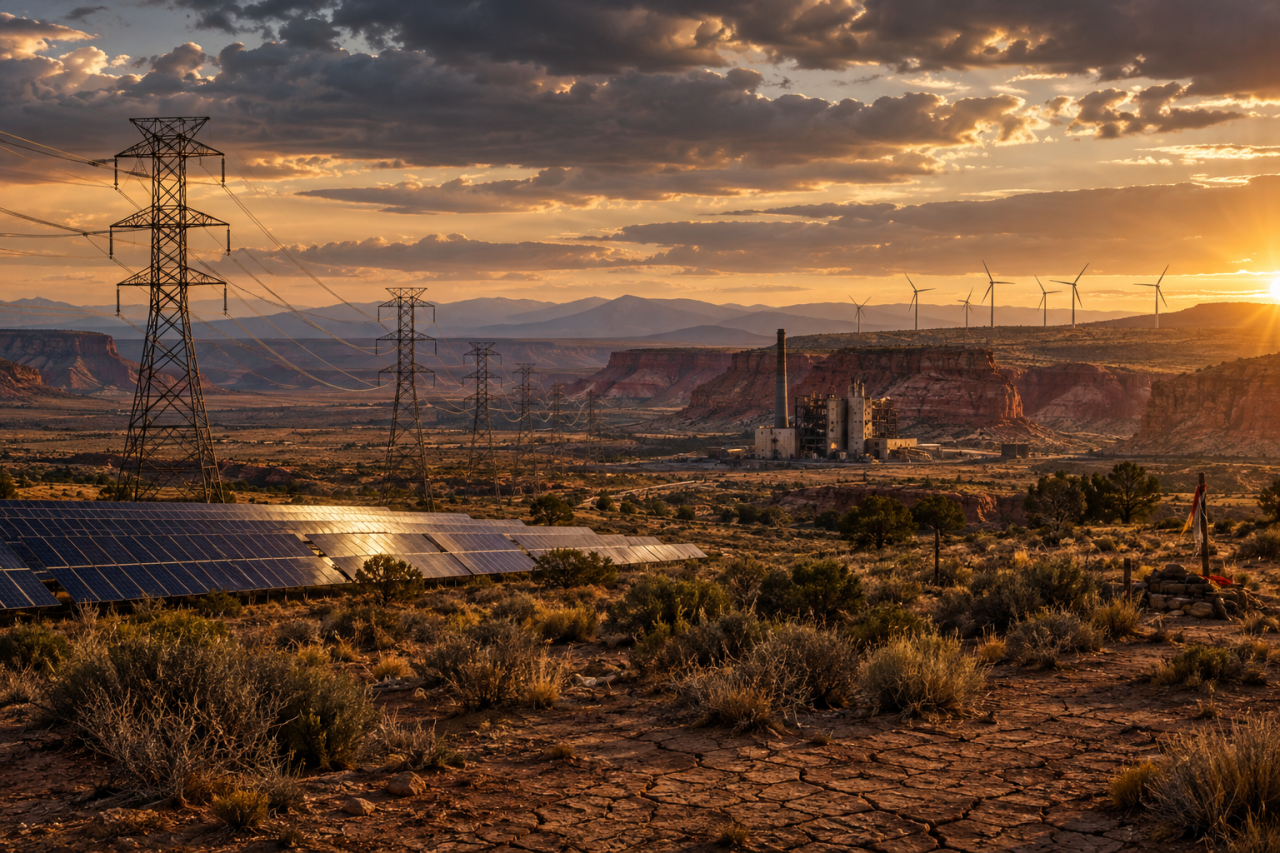
Nationally, the single most cited obstacle to renewable deployment is the grid itself. Interconnection queues in many regions now stretch years, and new transmission lines face permitting timelines that outlast political cycles. New Mexico has its own high-profile example in the long-delayed SunZia transmission project, which took more than a decade to clear federal and state hurdles. Without a faster, more predictable permitting pathway, the state’s wind-rich eastern plains and solar-rich south will struggle to move power to market.
Federal Policy Whiplash
State programs increasingly lean on federal tax credits and grants, which makes them vulnerable to shifts in Washington. Analysts have flagged this dependency as a systemic risk: a change in administration or a budget fight can upend project financing overnight. New Mexico’s clean energy pipeline, much of it financed with federal incentives, should be stress-tested against scenarios where that support shrinks or disappears.
Workforce and Supply Chain Strain
A shortage of skilled labor — linemen, electricians, battery technicians — is showing up in state after state as projects compete for the same limited talent pool. Add to that a global supply chain for solar panels, batteries, and critical minerals that remains concentrated overseas, and cost overruns become a near-certainty. New Mexico, with its coal-transition communities in the Four Corners region, has both a workforce challenge and an opportunity: retraining programs could convert displaced fossil-fuel workers into the backbone of a renewable buildout, if funded and scaled in time.
Revenue Volatility and Fiscal Risk
Perhaps the most New Mexico-specific risk is fiscal. Oil and gas revenue still funds a large share of the state budget, even as the state pushes to decarbonize its grid. Nationwide, researchers warn that states overly reliant on fossil fuel revenue to fund clean energy transitions risk a dangerous mismatch — using boom-era dollars to build a future that eventually eliminates that revenue source. New Mexico’s long-term budget planning needs to account for this paradox directly.
Water and Land Use Conflicts
Finally, solar and transmission development increasingly collides with water scarcity and land-use disputes, particularly on tribal lands. These conflicts have slowed projects in other arid states and are likely toK surface again in New Mexico’s own build-out.
None of these risks are unique to New Mexico, but their convergence here is distinctive enough that silence is not a strategy.
State leaders who name these risks early and build policy safeguards around them — will be better positioned to deliver on 2045 goals than those who treat clean energy as a straight line from legislation to execution.
FAQs
1. What is New Mexico’s goal for clean energy by 2045?
New Mexico aims to achieve 100% carbon-free electricity by 2045, as outlined in the 2019 Energy Transition Act. This ambitious target reflects the state’s commitment to transitioning to renewable energy sources.
2. What are the main challenges facing New Mexico’s clean energy goals?
New Mexico faces several key challenges in reaching its clean energy objectives, including:
- Transmission and interconnection bottlenecks
- Dependency on federal tax credits
- Workforce and supply chain shortages
- Fiscal risks associated with declining oil and gas revenue
- Water and land-use conflicts, especially on tribal lands
3. How do federal policies affect New Mexico’s clean energy initiatives?
State clean energy programs in New Mexico are increasingly dependent on federal tax credits and grants. Changes in federal administration or budget priorities can significantly impact project financing, making this reliance a systemic risk for the state’s clean energy pipeline.
4. What steps can policymakers take to address these risks?
Policymakers should proactively identify and address the risks threatening New Mexico’s clean energy goals. This includes creating predictable permitting pathways, securing long-term funding, investing in workforce retraining programs, and planning for potential conflicts over water and land use to ensure successful implementation of clean energy initiatives by 2045.